Asana and Alignment Basics
Use purpose, base, load, range, breath, effort, variation, and stop signals to make student-choice-centered asana decisions.
Learning purpose
Build shared language for base, load, range, breath, effort, variation, and stop signals.
Learning objectives
- Describe alignment in relation to a task rather than one appearance.
- Use options and stop signals to support student choice.
Prerequisites
Key topics
- Purpose
- Base of support
- Load
- Range
- Student choice
- Stop signals
- Asana
- Ahimsa
- Vinyasa
- Sthira
- Sukha
Also listed in: Foundations
On this page
Asana study includes more than pose names or a finished silhouette. It asks what a movement task is for, where the body meets support, how load and range are organized, whether breath and effort remain workable, and how a student can change or leave the task. Alignment is the reasoning that connects those observations; it is not one shape that every body must reproduce.
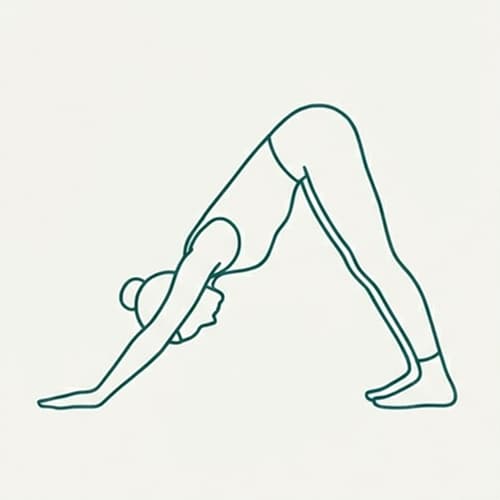
Alignment as a Decision Process
A visible position can suggest a useful question, but it cannot reveal pain, diagnosis, internal load, consent, or the student's goal. Start with the task and the student's feedback. Then decide whether a cue, prop, smaller range, different orientation, rest, or no change is the most relevant response. Recheck rather than assuming the first intervention worked.
Seven Shared Lenses
- Purpose: name the learning task—such as changing orientation, coordinating a transition, exploring balance, or bearing weight—without promising a health result.
- Base: notice every contact with floor, wall, chair, strap, block, or another support. A wider, higher, or more stable base changes the task.
- Load: ask what is receiving force and in which direction. Moving a hand, foot, prop, or body segment can redistribute rather than simply remove load.
- Range: choose a workable amount of joint and whole-body movement for this person, task, speed, and day. Maximum range is not the default goal.
- Breath and effort: notice whether breathing remains available and whether effort matches the intended dose. Breath is feedback, not a diagnostic test.
- Variation: proportions, mobility, strength, experience, injury history, fatigue, environment, and preference can all change a useful option.
- Exit and stop signals: the student should know how to reduce, leave, or replace the task before intensity rises.
Observe, Ask, Offer, Recheck
- State the task and a clear exit. Give students time to orient before adding detail.
- Observe contact, direction, pacing, transitions, breath, and signs of effort without labeling a body as wrong.
- Ask a neutral question such as 'How is the pressure in your wrists?' or 'Would you like more support?' Do not demand disclosure or infer a diagnosis.
- Offer one relevant choice: change the base, range, load, tempo, support, duration, or relationship to gravity.
- Recheck the student's feedback and the task. Keep, revise, or remove the option; more cueing is not automatically better teaching.
Student-Choice Examples
- In a standing balance, a student may use a wall, keep toes down as a kickstand, lower the gaze, or choose a two-foot version while preserving the orientation task.
- In Downward-Facing Dog, a student may bend the knees, shorten the stance, use hands on a wall or chair, rest on forearms where appropriate, or choose Child's Pose or tabletop instead.
- In a lunge, a student may shorten or widen the stance, lower the back knee onto support, reduce depth, use blocks, or exit to standing. The front knee does not need to match one universal visual landmark.
- In a seated fold, a student may sit higher, bend the knees, use a strap without pulling, remain upright, or choose a supported rest. A straight spine or contact with the legs is not proof of success.
Cue the Task, Not a Diagnosis
- Prefer observable, revisable language: 'Try moving the block higher and notice whether the transition becomes steadier.'
- Avoid causal certainty: 'Your pelvis is misaligned, so your back hurts' turns a visual guess into diagnosis.
- Avoid correction promises: no cue can guarantee injury prevention, perfect posture, detoxification, or permanent structural change.
- Describe options without ranking bodies: props and smaller ranges are ways to change a task, not evidence that a student is behind.
Key Terms
- Task: the specific movement or learning problem being explored, not a promised therapeutic outcome.
- Base of support: the contact area through which the body receives support.
- Load: force borne or transmitted through the body during a task; it changes with position, external support, speed, and effort.
- Range: the amount of movement used for a task, which may differ from a person's available maximum.
- Option: a genuine way to change or replace the task while preserving student agency.
- Stop signal: feedback that calls for ending or reassessing the task rather than pushing through.
Practice Reflection
Choose one familiar pose. Write its purpose in one sentence, then create three versions: change the base, redistribute load, and reduce range. For each version, add a neutral feedback question and a clear exit. Check that none of your choices depends on making every student look the same.
Quick Review
- Alignment begins with purpose and feedback, not an ideal silhouette.
- Base, load, range, breath, effort, variation, and exit choices make a cue specific and revisable.
- A teacher observes and asks; appearance alone cannot establish pain, diagnosis, or internal load.
- Props, smaller ranges, different orientations, rest, and refusal are ordinary learning choices.
- Stop signals call for pause and reassessment, not a correction promise or amateur diagnosis.
Sources and Further Study
- OpenStax Anatomy and Physiology 2e: Synovial Joints
Open anatomy textbook, accessed 2026-07-17. Used for joint structure, mobility, and the distinction between structural capacity and a task-specific movement choice.
- OpenStax Anatomy and Physiology 2e: Types of Body Movements
Open anatomy textbook, accessed 2026-07-17. Used for neutral movement vocabulary; it is not used to prescribe one yoga shape.
- National Center for Complementary and Integrative Health: Yoga—Effectiveness and Safety
U.S. National Institutes of Health safety overview, accessed 2026-07-17. Used for the need for qualified instruction, individual modifications, and realistic injury language.
- Yoga Alliance: Scope of Practice
Current professional-scope example, accessed 2026-07-17. Used for competence and referral boundaries; teachers must also follow their own role, jurisdiction, and venue policy.
Continue learning
Continue learning
Continue with published lessons, references, editorial reading, or a short exam check chosen for this topic.
Related Lessons
Lesson
Pose Families and Movement Patterns
Classify overlapping asana families by movement task, support, and load without assigning universal effects or sequence rules.
Lesson
Feet, Ankles, Knees and Legs
Observe lower-limb base, load, range, and feedback while offering stance and support choices without universal foot or knee rules.
Lesson
Hips, Pelvis and Spine
Relate hip, pelvic, and spinal movement to task, support, and range without prescribing one neutral pelvis or diagnosing posture.
Lesson
Shoulders, Arms, Hands, Wrists, Neck and Head
Observe upper-body movement and load while offering prop, range, gaze, and weight-bearing choices without universal hand or shoulder rules.
Lesson
Alignment Anatomy Deep Dive
Synthesize alignment decisions through cases using purpose, observation, feedback, load, range, options, consent, and scope.
Lesson
Anatomy for Yoga Students
Build a precise anatomy vocabulary, observe movement without diagnosing it, and evaluate body claims before applying them in yoga teaching.