Alignment Anatomy Deep Dive
Synthesize alignment decisions through cases using purpose, observation, feedback, load, range, options, consent, and scope.
Learning purpose
Integrate regional lessons through cases where cues return to purpose, choice, and scope rather than visual ideals.
Learning objectives
- Analyze an alignment case using task, load, range, and feedback.
- Choose a cue or option without making a diagnosis.
Prerequisites
Key topics
- Case analysis
- Observation
- Load and range
- Student feedback
- Consent
- Scope of practice
- Alignment
- Load
- Range
- Joint
On this page
Regional anatomy gives a teacher vocabulary; a case reveals whether that vocabulary is being used responsibly. This lesson integrates the M05 framework through ambiguous teaching situations. The goal is not to discover the perfect cue. It is to choose a bounded, testable response that fits the task, preserves student choice, and stays outside diagnosis or treatment.
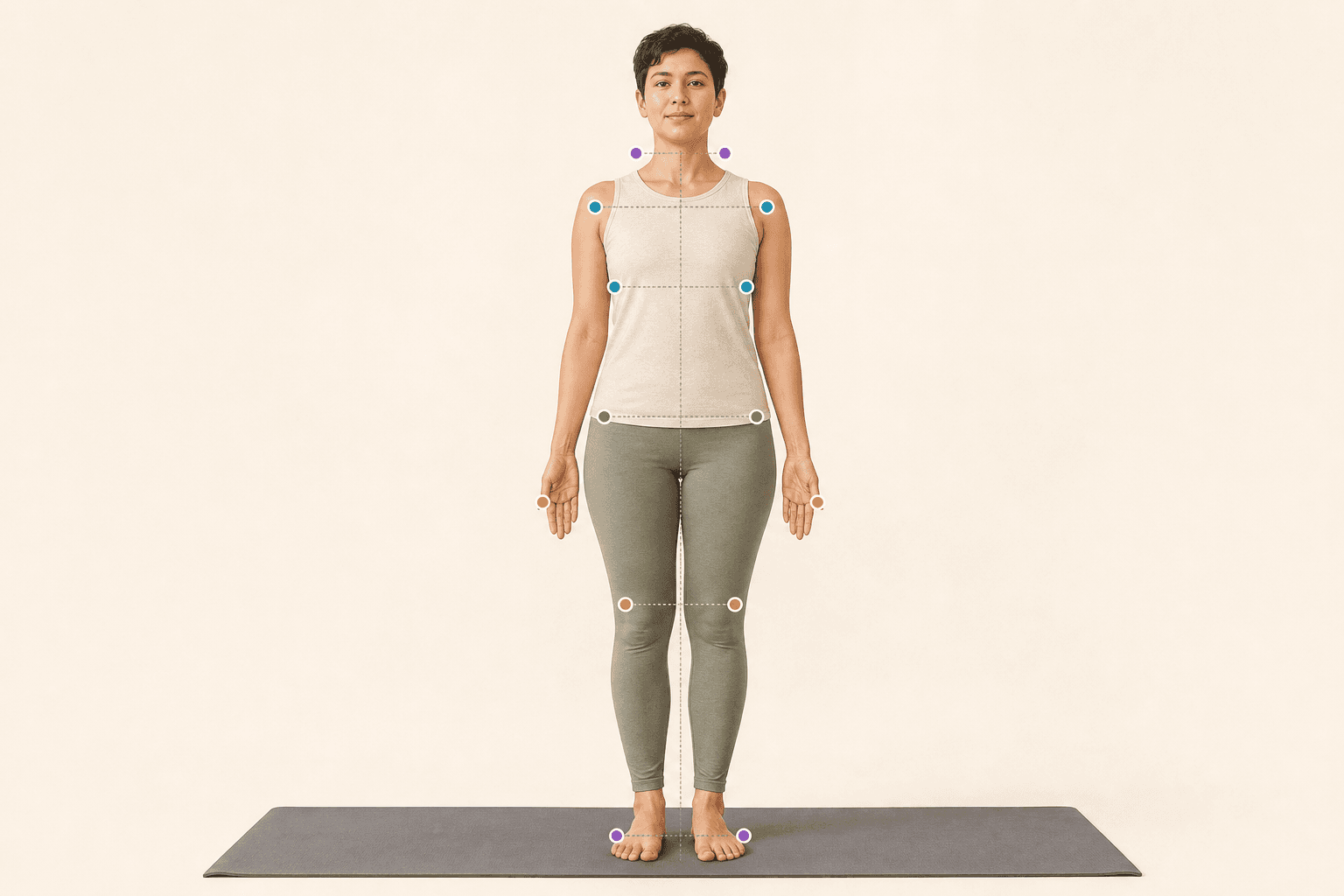
The Case Loop
- Purpose: state the specific learning or movement task. Remove any unsupported promise to fix posture, prevent injury, detoxify, or treat a condition.
- Observe: describe base, load, direction, range, transition, breathing, effort, and exit without attaching a diagnosis to appearance.
- Ask: invite the student's experience with a neutral question. They may answer, decline, change the task, or stop without defending the choice.
- Offer: change one relevant variable—support, stance, range, leverage, pace, duration, gaze, or relationship to gravity.
- Recheck: compare feedback and task after the change. Keep, revise, remove, or replace the option rather than stacking cues.
- Scope: pause and refer when symptoms, uncertainty, or the requested outcome exceeds yoga-teacher competence.
Observation, Interpretation, and Action
- Observation: 'The front knee moved forward as the student lowered.' This is visible and revisable.
- Student report: 'The student says the stance feels stable and comfortable.' This is information, not proof that every risk has been screened.
- Interpretation: 'The knee is unstable because the glutes are weak.' This is a causal or diagnostic claim that the observation does not establish.
- Action: 'Try shortening the stance or using blocks, then compare comfort and control.' This is a bounded experiment, not a correction promise.
Case 1: The Lunge Knee Moves Forward
A teacher sees a front knee move beyond the ankle and says it must return directly over the heel. Start again: is the task balance, transition, leg effort, or a particular lunge shape? Ask about comfort and control. Notice stance length, ankle range, foot contact, back-leg choice, trunk position, support, and exit. Try one change—shorter or wider stance, less depth, blocks, a lowered back knee, or standing support—and recheck. Forward knee travel is not automatically an error; restricting it can redistribute demand elsewhere.
Case 2: The Spine Rounds in a Forward Fold
A rounded back does not reveal a disc injury, tight hamstrings, weak core, or poor posture. Clarify whether the task is hip movement, spinal flexion, rest, or reaching. Ask how the fold feels. Options include bending the knees, sitting higher, supporting the hands or torso, reducing range, changing pace, or remaining upright. A hip hinge and a spinally flexed fold are different strategies; neither is universally correct for every person and purpose.
Case 3: Wrist or Shoulder Discomfort in Downward-Facing Dog
Do not diagnose hand weakness or shoulder impingement and then add more pressure. Invite the student to leave the load first. Ask what they noticed and whether they want another task. A wall, chair, higher support, shorter duration, bent knees, tabletop, forearm version where appropriate, or rest changes leverage, range, and load. Recheck hands, wrists, shoulders, neck, breath, and exit—not only the final shape.
Case 4: The Pelvis Is Not 'Open Enough' in Triangle
A teacher tries to rotate a student's pelvis until it matches a preferred photograph. Replace the visual ideal with a task: standing balance, lateral reach, rotation, or another focus. Let stance, foot angles, hand support, torso range, top-arm position, and gaze change. The pelvis and spine can share movement; neither perfectly square nor fully open is universally required. Do not use hands-on force to manufacture the teacher's chosen geometry.
Key Terms
- Observation: a neutral description of what occurred, separate from a causal story.
- Interpretation: a proposed meaning or mechanism that may require evidence and qualified assessment.
- Bounded experiment: one reversible task change followed by feedback and re-evaluation.
- Load redistribution: changing where and how demand is shared rather than assuming a cue eliminates force.
- Scope boundary: the point at which teaching must pause, refer, or defer because competence or authority is insufficient.
Practice Reflection
Choose one case above. Write a six-line response: purpose, neutral observation, student question, one reversible option, what you will recheck, and the scope boundary. Then underline every word that implies a diagnosis or universal rule and rewrite it as an observable, optional teaching decision.
Quick Review
- Cases begin with purpose and a neutral observation, not a visual correction.
- Ask before assuming; then change one variable and recheck the task and student's feedback.
- A cue redistributes demand and cannot guarantee protection, treatment, or a perfect shape.
- Consent is specific and revocable; student choice includes rest, replacement, and no touch.
- Warning symptoms and unresolved uncertainty require pause, scope awareness, and appropriate support.
Sources and Further Study
- OpenStax Anatomy and Physiology 2e: Types of Body Movements
Open anatomy textbook, accessed 2026-07-17. Used for neutral joint and body-region movement vocabulary rather than prescriptive yoga geometry.
- Fry, Smith, and Schilling: Effect of Knee Position on Hip and Knee Torques During the Barbell Squat
Small comparative biomechanics study, 2003. Used to demonstrate redistribution of demand when forward knee travel was restricted; not generalized into an injury rule or yoga prescription.
- Phadke, Camargo, and Ludewig: Scapular and Rotator Cuff Muscle Activity During Arm Elevation
Peer-reviewed review with open full text, 2009. Used to support the moving-scapula context of arm elevation without diagnosing shoulder symptoms from appearance.
- National Center for Complementary and Integrative Health: Yoga—Effectiveness and Safety
U.S. National Institutes of Health safety overview, accessed 2026-07-17. Used for qualified instruction, modification, and realistic risk framing.
- Yoga Alliance: Scope of Practice
Current professional-scope example, accessed 2026-07-17. Used for competence and referral boundaries; local law, role, and venue policy still govern practice.
Continue learning
Continue learning
Continue with published lessons, references, editorial reading, or a short exam check chosen for this topic.
Related Lessons
Lesson
Asana and Alignment Basics
Use purpose, base, load, range, breath, effort, variation, and stop signals to make student-choice-centered asana decisions.
Lesson
Feet, Ankles, Knees and Legs
Observe lower-limb base, load, range, and feedback while offering stance and support choices without universal foot or knee rules.
Lesson
Hips, Pelvis and Spine
Relate hip, pelvic, and spinal movement to task, support, and range without prescribing one neutral pelvis or diagnosing posture.
Lesson
Shoulders, Arms, Hands, Wrists, Neck and Head
Observe upper-body movement and load while offering prop, range, gaze, and weight-bearing choices without universal hand or shoulder rules.
Lesson
Anatomy for Yoga Students
Build a precise anatomy vocabulary, observe movement without diagnosing it, and evaluate body claims before applying them in yoga teaching.
Lesson
Teaching Tools and Adjustments
Use a non-touch-first ladder for teaching adjustments and apply explicit, informed, specific, current, revocable, no-consequence consent whenever physical contact is considered.